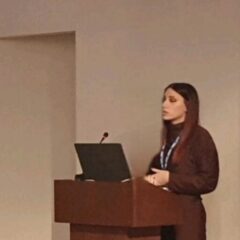
In November 2025, I participated as a Fellow member of the AI Lang project team in the Workshop on Artificial Intelligence in Language Education, held at the European Centre for Modern Languages (ECML) of the Council of Europe in Graz, Austria. As part of the project team, I contributed to the development of the Guidelines for the Use of AI in Language Education, a key deliverable of the AI Lang initiative. During the workshop, I took part in collaborative sessions focusing on AI-supported language teaching, the ethical use of artificial intelligence, and pedagogical innovation, working alongside experts and educators from across Europe to shape informed, responsible approaches to AI integration in language education.
Konstantina Alevizou holds a strong academic foundation in the fields of English language teaching and applied linguistics. She earned her BA in English Language and Literature from the National and Kapodistrian University of Athens, followed by an MA in Applied Linguistics with honors (Cum Laude) from the Hellenic American University. Her academic focus has extended to inclusive teaching practices and the integration of digital tools in language education. She is currently pursuing a second Master’s degree in Technologies of Learning and Communication with a specialization in STEAM training at the European University of Cyprus, further enhancing her expertise in digital pedagogies and innovative instructional methods.
When she is not working or studying, Konstantina is an outgoing person who enjoys indulging herself into the pleasures that the Arts offer, since she finds delight in watching theatrical performances, art exhibitions and music concerts. In addition, she is intrigued by reading classical novels and philosophical books. Finally, she is fascinated by travelling to different parts of the world in order to broaden her horizons and immerse herself into different cultures and mindsets.
Explore recent academic articles by K. Alevizou on AI in education, inclusive practices, and multilingual teaching innovation.
My academic papers target research areas such as…
AI hallucinations
Abstract: The present article comprises a literature review of the AI-generated hallucinations in educational contexts along with examples of previous research, where AI tools may produce false, misleading or fabricated information. The risks of such errors are explored, their implications for students and educators are demonstrated and finally strategies and pedagogical implications are suggested in order for this phenomenon to be alleviated and eventually annihilated. A key target of this paper is on developing constructive questioning techniques which will promote critical engagement with AI outputs.
Fostering Multilingual Proficiency Trilingualism in Greek Primary Schools
Abstract: This conceptual paper investigates the implementation of trilingual education in Greek primary schools, with a particular focus on students who have learning disabilities. This article examines how trilingual curricula—encompassing Greek, English, and an additional foreign language—can be designed to support diverse learning needs. Results indicate that well-structured trilingual programs, bolstered by differentiated instructional strategies and assistive technologies, can enhance language acquisition and academic self-esteem among learners with learning disabilities. Additionally, collaborative planning between mainstream and special education teachers emerged as a vital component in addressing individual student challenges. These issues highlight the need for sustained teacher training, resource allocation, and inclusive policy frameworks that promote equal access to language learning opportunities. Ultimately, this paper underscores the transformative potential of trilingual education in fostering both linguistic proficiency and social inclusion for all students in Greek primary schools.
Abstract: Using videos in teaching is a novel teaching technique which has been widely applied by educators all over the world. YouTube consists a teaching tool which has been in our lives almost a decade. Evidently, it has penetrated almost every domain of both personal and professional aspects of human nature. This paper explores the use of the YouTube platform as a tool in kindergarten English as a Foreign Language (EFL) teaching. Secondly, the effects of visuals and video technology on pre-school students are going to be discussed. Additionally, this analysis reflects on possible drawbacks and limitations that the use of YouTube effectuates in the EFL classroom and whether the students are positively or negatively motivated towards the foreign language. Finally, pedagogical implications and suggestions will be recommended for effective teaching implementation of the aforementioned platform based on the writer’s personal experience.
Teaching English Grammar Through Automated Essay Scoring Systems
The article explores the challenges of teaching English grammar and compares deductive (rule-based, teacher-centered) and inductive (example-based, student-centered) approaches. It highlights the growing role of Automated Essay Scoring (AES) systems, powered by AI, NLP, and machine learning, in grammar instruction. Tools like Grammarly and Criterion provide immediate feedback, support personalized learning, and reduce teacher workload. AES promotes formative assessment, error analysis, and flipped classroom practices while boosting student engagement. However, limitations include misidentifying errors, lack of explanations, and risks of over-reliance. The article concludes that AES should supplement—not replace—teacher feedback for effective grammar learning.
Building Effective Study Habits in Students Through AI Tools: The Case of AI Tool Habitica
The article examines how AI can support the development of effective study habits, focusing on the gamified productivity app Habitica. Effective study habits are essential for academic success, and AI can enhance them by fostering motivation, accountability, and consistency. Habitica turns real-life tasks into a role-playing game, rewarding students for completing daily goals, building positive habits, and tracking progress. Its social features promote collaboration, accountability, and community support. While the app can boost motivation and engagement, limitations include potential overreliance on AI, reduced creativity, and risks of passive learning. The article concludes that AI should complement—not replace—teacher guidance.
ABSTRACT This conceptual paper investigates the implementation of trilingual education in Greek primary schools, with a particular focus on students who have learning disabilities. This article examines how trilingual curricula—encompassing Greek, English, and an additional foreign language—can be designed to support diverse learning needs. Results indicate that well-structured trilingual programs, bolstered by differentiated instructional strategies and assistive technologies, can enhance language acquisition and academic self-esteem among learners with learning disabilities. Additionally, collaborative planning between mainstream and special education teachers emerged as a vital component in addressing individual student challenges. These issues highlight the need for sustained teacher training, resource allocation, and inclusive policy frameworks that promote equal access to language learning opportunities. Ultimately, this paper underscores the transformative potential of trilingual education in fostering both linguistic proficiency and social inclusion for all students in Greek primary schools.
Keywords: Trilingualism, Cognitive development, Language proficiency, Teaching strategies, Learning disabilities
With a strong foundation in English language education and applied linguistics, I am eager to participate in the Crossing: Learning Bridges Across the Atlantic program to foster deeper intercultural collaboration and pedagogical exchange. My professional journey as an ESL/EFL teacher across diverse Greek educational contexts—ranging from kindergartens to adult learners—has been shaped by a continuous engagement with inclusive practices and digital innovation. I am particularly drawn to the program’s mission of building educational bridges, as my own research explores the intersection of AI-supported learning and multilingual competence, areas that transcend national boundaries. My previous collaborations with U.S.-based institutions, such as the Hellenic American Union, and my ongoing graduate studies in educational technology position me to contribute meaningfully to transatlantic dialogue. I envision this program as a unique opportunity to exchange best practices, co-develop inclusive language teaching frameworks, and enrich my understanding of how educational values are shared and transformed across cultures.
A passionate educator-researcher, Konstantina has actively contributed to professional discourse through numerous publications and conference presentations. Her recent work explores AI-assisted writing tools, inclusive STEAM methodologies, and the use of digital platforms like YouTube in early language instruction. She has co-authored and presented research at high-profile venues, including TESOL Greece and the Bright Start International Conference. Additionally, she has submitted several academic articles for publication that address contemporary challenges in language education, such as AI hallucinations and trilingualism in learners with disabilities. Her dual role as a practitioner and researcher reflects a commitment to continuous learning and pedagogical innovation.
📚Publications
Alevizou, K., Fratzeskaki, E. (2025). Enhancing Learners’ Writing Competence through the Integration of AI-Powered Writing Assistance Tools in the Instruction of English and French as Foreign Languages. (Article submitted for publishing).
Alevizou, K. (2025). Smarter Questions, Smarter AI: Helping Students Navigate AI Hallucinations in Learning. (Article submitted for publishing).
Alevizou, K., Fratzeskaki, E. (2025). Empowering Young Minds: Inclusive AI-Enhanced STEAM Teaching for Primary and Early Childhood Learners. (Submitted to 2025 Bright Start International Conference).
Alevizou, K., Fratzeskaki, E. (03/2025). Steam & Inclusive Education in Foreign Language Learning. TESOL Greece Convention.
Alevizou, K., Fratzeskaki, E. (2025). Fostering Multilingual Proficiency: Trilingualism in Greek Primary Schools – The case of children with learning disabilities. 2nd Symposium of Language Education and Research, Thessaloniki, Greece.
Alevizou, K. (2024). YouTube as a Valuable Instructional Tool in Teaching Young Learners: Harvesting its Benefits. CFL Journal, 6, 12–15.
Alevizou, K., Fratzeskaki, E. (2023). Examining Cultural Contexts in Textbooks. Impact on students with disabilities. ELT NEWS Magazine, Issue 395.
Alevizou, K. (2023). Promoting Excellence in Advanced C2-level Students: Error Analysis as a Teaching Tool. CFL Journal, 4, 3–5.
Alevizou, K. (2023). Promoting Excellence in Advanced C2 level – Student Essays. Error Analysis and Feedback.i-Teacher, Issue 39, 154–157.
Alevizou, K. (2023). Promoting Excellence in Advanced C2-level Students: Error Analysis as a Teaching Tool. ELT NEWS Magazine, Issue 389, 20–21.
📣 Announcements
Alevizou, K. (27–29/09/2024). YouTube in Kindergarten Teaching: Using Online Videos in Teaching English as a Foreign Language. 8th Panhellenic Conference, ETPE.
Alevizou, K., Fratzeskaki, E. (03/2023). Examining Cultural Contexts in Textbooks. Impact on students with disabilities. TESOL Greece Convention.
Alevizou, K., Fratzeskaki, E. (02/12/2023). Enhancing Inclusive Teaching Practices in Mixed Ability Classrooms. Institute of Culture, Democracy and Education (IPODE).
With over a decade of hands-on experience, Konstantina has served as an ESL/EFL teacher across diverse educational settings, from state kindergartens and private primary schools to adult education centers and one-on-one tutoring. She has consistently demonstrated the ability to design inclusive and engaging curricula tailored to mixed-ability learners, particularly in early childhood education. Her teaching journey includes roles in reputable institutions such as I.M. Panagiotopoulos School and Pedagogiki – BIRDS Private School, where she also took initiative in extracurricular projects such as student theatre productions and museum visits. In parallel, she has collaborated extensively with language assessment bodies, serving as an oral examiner, interlocutor, and proctor for organizations such as the Hellenic American Union, ESB, Esolnet Hellas, and Pearson.